
Choosing the right insulation plays a major role in your home’s comfort, energy efficiency, and long-term cost savings. Among modern insulation solutions, spray foam insulation is one of the most effective options. However, homeowners often struggle to decide between open cell foam insulation and closed cell foam insulation.
Both types are widely used in residential and commercial buildings, but they perform differently in terms of cost, durability, moisture resistance, and energy efficiency. In this guide, we’ll break down the difference between open cell foam and closed cell foam, compare their benefits, and help you decide which one is better for your home insulation needs.
What Is Spray Foam Insulation?
Before comparing the two types, it’s important to understand what spray foam insulation is.
Spray foam insulation is a liquid material that expands into a foam when applied. It fills gaps, cracks, and cavities, creating an airtight seal that improves energy efficiency and reduces heat loss.
There are two main types:
- Open cell foam insulation
- Closed cell foam insulation
Both are made from polyurethane but differ in structure and performance.
What Is Open Cell Foam Insulation?
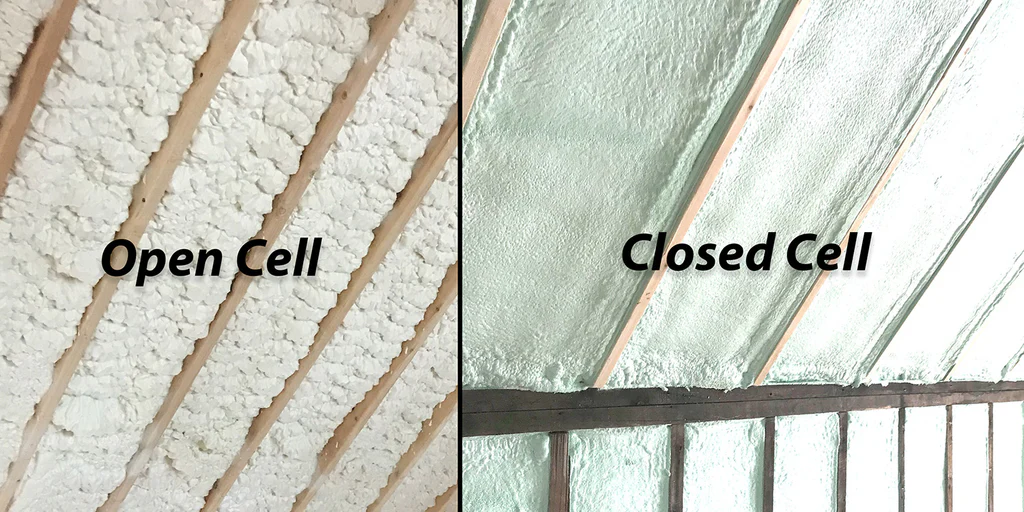
Open cell foam insulation is a lightweight, flexible foam where the cells are not completely closed. The structure allows air to fill the open spaces, making it softer and less dense.
Key Features of Open Cell Foam:
- Lower density material
- Soft and flexible texture
- Expands significantly after application
- Air-permeable (allows some air movement)
- Lower R-value per inch
R-Value of Open Cell Foam:
Typically around R-3.5 to R-4 per inch
What Is Closed Cell Foam Insulation?
Closed cell foam insulation is a dense, rigid foam where the cells are completely closed and tightly packed. This structure makes it stronger and more resistant to air and moisture.
Key Features of Closed Cell Foam:
- High-density material
- Hard and rigid structure
- Very strong and durable
- Acts as a moisture barrier
- Higher R-value per inch
R-Value of Closed Cell Foam:
Typically around R-6 to R-7 per inch
Open Cell Foam vs Closed Cell Foam: Key Differences
Understanding the open cell foam vs closed cell foam insulation comparison is essential before making a decision.
1. Insulation Performance (R-Value)
Closed cell foam provides nearly double the R-value compared to open cell foam. This means:
- Closed cell = higher energy efficiency
- Open cell = moderate insulation performance
✔ Winner: Closed Cell Foam
2. Air and Moisture Barrier
- Open cell foam allows some air and moisture movement
- Closed cell foam blocks air and resists moisture completely
This makes closed cell foam ideal for areas exposed to humidity or water risks.
✔ Winner: Closed Cell Foam
3. Cost Comparison
- Open cell foam insulation is more affordable
- Closed cell foam insulation is more expensive due to density and material strength
If budget is a concern, open cell foam is often preferred.
✔ Winner: Open Cell Foam
4. Soundproofing Ability
- Open cell foam absorbs sound better due to its soft structure
- Closed cell foam is less effective for sound insulation
For interior walls and sound control, open cell foam performs better.
✔ Winner: Open Cell Foam
5. Strength and Durability
Closed cell foam is extremely strong and adds structural reinforcement to walls and roofs.
Open cell foam is flexible but not structural.
✔ Winner: Closed Cell Foam
6. Expansion and Coverage
- Open cell foam expands more, covering larger areas with less material
- Closed cell foam expands less but provides denser coverage
✔ Winner: Open Cell Foam (for coverage efficiency)
Benefits of Open Cell Foam Insulation
Open cell foam is widely used in residential insulation due to its affordability and flexibility.
Advantages:
- Lower installation cost
- Excellent sound absorption
- Good for interior walls and ceilings
- Expands to fill tight spaces
- Breathable structure reduces condensation issues
Best Applications:
- Interior walls
- Attics (non-moisture-prone areas)
- Soundproof rooms
- Budget-friendly insulation projects
Benefits of Closed Cell Foam Insulation
Closed cell foam is considered premium insulation due to its strength and performance.
Advantages:
- High R-value per inch
- Strong moisture barrier
- Adds structural strength to buildings
- Ideal for extreme weather conditions
- Long-lasting insulation performance
Best Applications:
- Basements
- Exterior walls
- Roofs and roofing systems
- Areas exposed to moisture
- Commercial buildings
Cost of Spray Foam Insulation
The spray foam insulation cost depends on type, thickness, and installation area.
- Open cell foam: More affordable per square foot
- Closed cell foam: Higher cost but better long-term efficiency
While closed cell foam costs more upfront, it can reduce energy bills more significantly over time.
Which Is Better for Home Insulation?
The answer depends on your specific needs.
Choose Open Cell Foam If:
- You want a budget-friendly insulation option
- Soundproofing is important
- You are insulating interior walls or ceilings
- Moisture exposure is low
Choose Closed Cell Foam If:
- You want maximum energy efficiency
- You need moisture protection (basements, roofs)
- You want stronger structural support
- You are in extreme climates
Final Verdict
When comparing open cell foam vs closed cell foam insulation, there is no one-size-fits-all answer.
- Closed cell foam is better for performance, durability, and moisture resistance
- Open cell foam is better for affordability and soundproofing
For most homeowners, a combination of both is often the best solution—open cell foam for interior comfort and closed cell foam for exterior protection.
Conclusion
Understanding the difference between open cell foam and closed cell foam helps you make a smarter investment in your home. Both insulation types offer unique advantages depending on your goals—whether it’s energy savings, sound control, or moisture protection.
If your priority is long-term efficiency and durability, closed cell foam is the better choice. If you are looking for cost-effective insulation with good soundproofing, open cell foam is ideal.
Choosing the right insulation ensures a more comfortable, energy-efficient, and protected home for years to come.